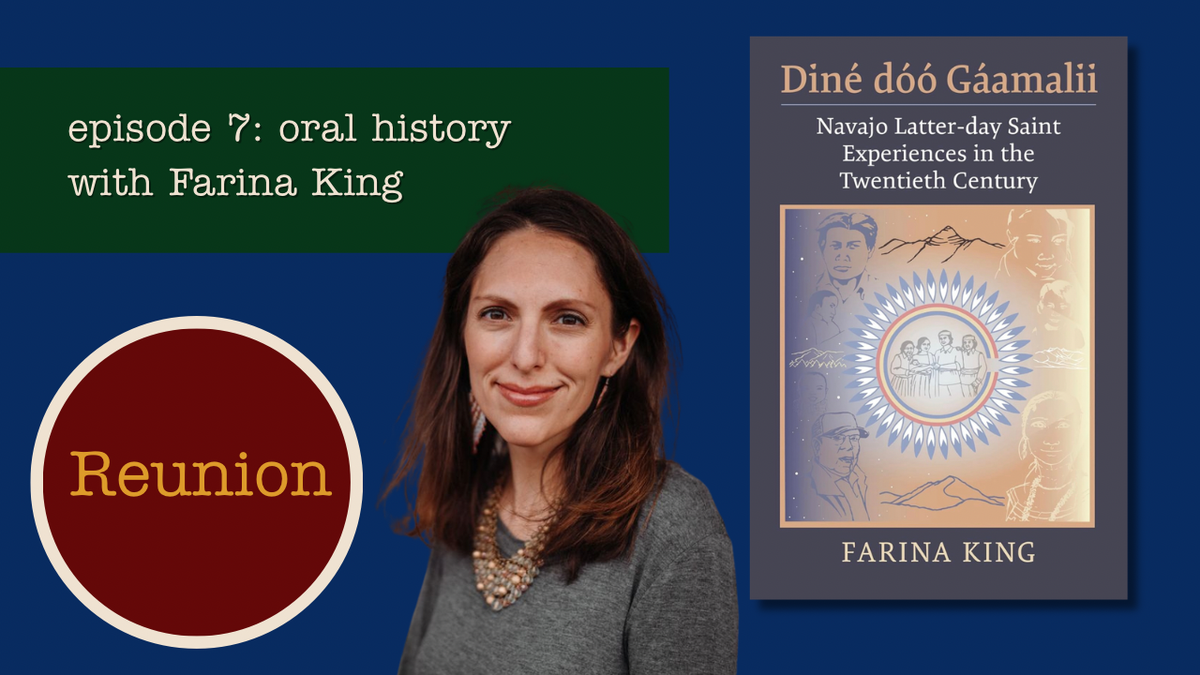
Reunion 007: Oral History with Farina King
In eighteenth-century England, not every family story turned on courtship and heirs. Many households were held together by single adults who managed budgets, cared for nieces and nephews, and kept the letters and ledgers that became a family’s memory. Their lives were both social and practical. Music in the parlor. Trips on the Thames. Decisions made around a shared table rather than an altar. When we shift our view from marriage and descent to the bonds among siblings and cousins, we see a different map of kinship. It is lateral. It is durable. It shapes how families work.
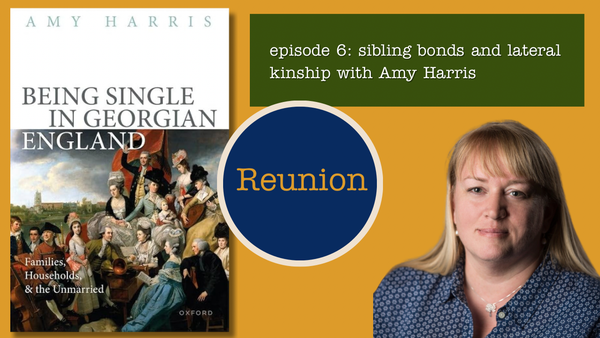
In today’s episode of Reunion, we explore that world through Amy Harris’s Being Single in Georgian England: Families, Households, and the Unmarried, a study of the Sharp family across three generations that shows how unmarried kin shaped household economies, caregiving, philanthropy, and abolitionist work; it asks us to see aunts and uncles and single siblings as central actors in family governance and legacy, suggests genealogy is about values as much as property, and invites us to read portraits, epitaphs, and paper trails for the stories singles preserved; and Amy Harris joins us to discuss single sociability, householding beyond marriage, and how re-centering lateral kin changes what family history can do.
LISTEN TO THE SHOW
Listen on Apple Podcasts: LINK
Listen on Spotify: LINK
Follow us on Instagram
TODAY'S GUEST
In a quiet kitchen on the Diné (Navajo Nation) reservation, a grandmother begins to speak. There’s no script, no microphone, just her voice, steady and rich with memory. She tells of boarding schools, of ceremonies held in secret, of laughter shared under desert skies. Her story isn’t written in books or stored in archives. It lives in her words, passed from one generation to the next.
For Farina King, these stories are history. In her work as a historian and citizen of the Navajo Nation, she listens to voices often left out of official records. Oral histories, she shows us, are not just sources. They are relationships. They carry emotion, identity, and the power to connect past and present in deeply personal ways.
Today, Dr. King joins us to discuss how oral histories transform our understanding of families, communities, and the significance of history itself. We’ll explore how listening, truly listening, can be an act of scholarship, of care, and of cultural survival.
SHOW NOTES
- TODAY'S GUEST
Farina King, a citizen of the Navajo Nation, is Horizon Chair of Native American Ecology and Culture and Professor of Native American Studies at the University of Oklahoma. She received her PhD in History from Arizona State University. Her research focuses on twentieth-century Native American history, with particular attention to Indigenous educational experiences, oral history, and the cultural and environmental contexts of boarding schools.
She is the author of The Earth Memory Compass: Diné Landscapes and Education in the Twentieth Century, which examines Diné relationships to land, memory, and schooling. She is co-author, with Michael P. Taylor and James R. Swensen, of Returning Home: Diné Creative Works from the Intermountain Indian School, and the author of Diné dóó Gáamalii: Navajo Latter-day Saint Experiences in the Twentieth Century, which explores Navajo religious, cultural, and community life within twentieth-century Mormon contexts.
Dr. King serves as a series editor for the Lyda Conley Series on Trailblazing Indigenous Futures at the University Press of Kansas and is co-editor of Palgrave Studies in Oral History. She is Editor in Chief of the Oxford Research Encyclopedia of Indigenous Studies. She also co-hosts the Native Circles podcast with Dr. Davina Two Bears and Eva Bighorse. From 2021 to 2022, she served as President of the Southwest Oral History Association.
SHOW NOTES
- Amy Bowers Cordalis, The Water Remembers: My Indigenous Family's Fight to Save a River and a Way of Life (Little, Brown, and Company, 2025).
- Fear-Segal and Susan D. Rose, Carlisle Indian Industrial School: Indigenous Histories, Memories, and Recolamations (University of Nebraska Press, 2018).
- Farina King, The Earth Memory Compass: Diné Landscapes and Education in the Twentieth Century (University Press of Kansas, 2018).
- Farina King, Returning Home: Diné Creative Works from the Intermountain Indian School (University of Arizona Press, 2021).
- Farina King, Diné dóó Gáamalii: Navajo Latter-day Saint Experiences in the Twentieth Century (University Press of Kansas, 2023).
- Farina King and Wade Davies, eds., COVID-19 in Indian Country: Native American Memories and Experiences of the Pandemic (Palgrave MacMillan, 2024).
- Farina King, "It's Time to Reconcile and Understand the Painful History of Indian Boarding Schools," Deseret News (Salt Lake City, UT), December 4, 2025.
- Nepia Mahuika, Rethinking Oral History and Tradition: An Indigenous Perspective (Oxford University Press, 2019).
- Lindsey Willow Smith (Bio Page)
- Kim Tallbear, Native American DNA: Tribal Belonging and the False Promise of Genetic Science (University of Minnesota Press, 2013).